
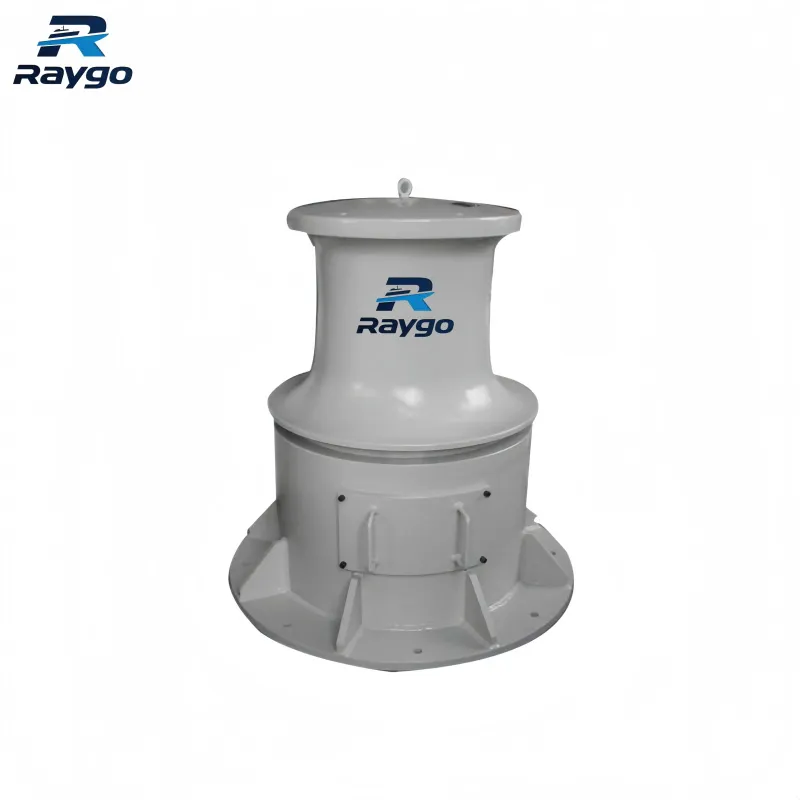
Hydraulic Marine Capstan | Heavy Duty Capstan for Mooring & Continuous Deck Traction
Raygo Marine supplies hydraulic marine capstans for vessel mooring, berthing, auxiliary towing, anchoring assistance, and heavy-duty rope handling. Powered by a hydraulic motor, the capstan provides strong low-speed torque, smooth speed control, and stable traction for frequent or demanding marine deck operations.
- Designed for marine mooring, towing assistance, and heavy-duty rope handling
- Hydraulic motor provides strong torque at low operating speeds
- Smooth speed adjustment through hydraulic flow control
- Forward and reverse operation for flexible rope handling
- Hydraulic pressure control supports convenient overload protection
- Suitable for frequent and demanding marine deck operations
- Compact vertical arrangement helps reduce deck-space requirements
- Pulling force, rope diameter, hydraulic pressure, flow, and motor configuration can be customized for project requirements
Accreditation and Certificates:

The Hydraulic Marine Capstan is a heavy-duty deck traction device powered by a hydraulic motor. It is designed for marine mooring, berthing, auxiliary towing, anchoring assistance and frequent rope-handling operations where stable pulling force, low-speed high torque and continuous operation are important.
Hydraulic pressure is converted into mechanical rotation through the hydraulic motor. The rotating capstan drum then transfers force to the rope through friction, allowing the rope to be pulled continuously without being stored on the drum.
The hydraulic drive system offers smooth speed regulation, strong low-speed torque and convenient overload protection, making hydraulic marine capstans particularly suitable for workboats and vessels with frequent or demanding deck traction duties.
Technical Specifications:
| Parameter | Configuration |
| Drive Type | Hydraulic |
| Rated Pull | According to project requirement |
| Working Speed | According to operating requirement |
| Rope Diameter | According to rope specification |
| Hydraulic Pressure | According to system design |
| Hydraulic Flow | According to motor and speed |
| Hydraulic Motor | Selected according to torque |
| Reduction Gear | Optional according to design |
| Brake System | Project-specific |
| Speed Control | Hydraulic flow control |
| Certification | According to project requirements |
Hydraulic pressure and flow should be matched with the selected motor, pulling force and operating speed as a complete system.
Key Features:
- High Torque at Low Speed: Hydraulic motors are well suited to delivering strong torque at relatively low operating speeds, making them suitable for demanding marine traction.
- Stable Heavy-Duty Output: A correctly designed hydraulic system can provide stable power for frequent and high-load operations.
- Smooth Speed Regulation: Hydraulic flow control allows operating speed to be adjusted smoothly according to line-handling requirements.
- Convenient Overload Protection: Pressure-control components can be incorporated into the hydraulic circuit to provide overload protection.
- Suitable for Frequent Operation: Strong torque, stable output and flexible control make hydraulic capstans suitable for vessels with frequent mooring and berthing operations.
- Compact Deck Arrangement: The vertical capstan drum provides a compact rope-handling arrangement.
Working principle:
- Step 1 – Hydraulic Pressure Is Generated: A hydraulic power source supplies pressurized hydraulic oil to the capstan circuit.
- Step 2 – Hydraulic Flow Is Controlled: Hydraulic valves regulate oil direction, pressure and flow according to operating requirements.
- Step 3 – Hydraulic Motor Converts Energy: Pressurized oil enters the hydraulic motor, where hydraulic energy is converted into rotational mechanical energy.
- Step 4 – Capstan Drum Generates Traction: The motor drives the capstan drum directly or through a reduction gearbox. Rope wrapped around the drum is pulled through friction.
- Step 5 – Hydraulic Control Regulates Operation: By controlling hydraulic flow and pressure, the system can manage start, stop, forward and reverse rotation, speed and overload protection.
Main Components:
- Capstan Drum: The drum provides the friction surface used to transfer torque to the rope.
- Hydraulic Motor: The hydraulic motor converts hydraulic pressure energy into rotary mechanical power.
- Reduction Gearbox: A reduction gearbox may be incorporated where lower speed and increased torque are required.
- Brake System: The brake provides stopping and holding functions and helps prevent unwanted reverse movement.
- Sealed Bearing Assembly: Bearings support rotating components, while seals help protect the internal mechanism from seawater, rain and contaminants.
- Hydraulic System: The hydraulic system supplies and controls hydraulic energy for the motor.
- Deck Base: The base connects the capstan to the ship structure and transfers operational loads into the deck foundation.
Applications:
- Frequent Mooring and Berthing: Hydraulic capstans are particularly suitable for vessels that repeatedly arrive at and leave berths and require frequent rope handling.
- Auxiliary Towing: Their high-torque characteristics make them suitable for auxiliary traction and towing-support applications within the designed load range.
- Auxiliary Anchoring: The capstan can assist with suitable anchoring-related rope or chain handling according to the vessel’s deck arrangement.
- Workboat Operations: Workboats and engineering vessels often require repeated low-speed pulling operations where hydraulic control provides useful flexibility.
- Heavy-Duty Deck Traction: Where strong pulling force and frequent duty are required, a properly matched hydraulic system can provide a stable traction solution.
Installation Requirements:
A hydraulic marine capstan should be installed on a deck foundation capable of safely transferring the full operating load into the vessel structure.
The mounting surface should be level and correctly aligned. Uneven foundations may result in abnormal loading of the drum, bearings and transmission components.
Installation planning should include foundation strength, rope force direction, hydraulic piping, return lines, operating clearance and maintenance access.
Hydraulic piping should be arranged to minimize unnecessary pressure loss and should be properly secured and protected.
Maintenance Guide:
Hydraulic equipment reliability depends heavily on hydraulic oil cleanliness, lubrication and effective sealing.
- Capstan Drum: Inspect for cracks, burrs, corrosion and abnormal wear.
- Bearings: Check lubrication and sealing conditions regularly.
- Hydraulic Oil: Monitor hydraulic oil level, cleanliness and overall oil condition.
- Filters: Inspect and replace or clean hydraulic filters according to the maintenance schedule.
- Hydraulic Motor and Pump: Check for abnormal noise, leakage, temperature rise and performance changes.
- Hydraulic Valves: Inspect valve operation and check for leakage or unstable pressure control.
- Hoses and Pipes: Check for leakage, abrasion, loose connections and damage.
- Deck Base: Inspect the base for corrosion and confirm that mounting bolts remain secure.
Hydraulic vs. Electric Marine Capstan:
| Factor | Hydraulic | Electric |
| Power Source | Hydraulic system | Electrical system |
| Low-Speed Torque | Strong advantage | Good |
| Speed Regulation | Smooth hydraulic control | Electrical control |
| Heavy-Duty Operation | Strong advantage | Depends on system design |
| System Requirement | Hydraulic circuit required | Electrical supply required |
| Typical Application | Frequent and heavy duty | General mooring |
A hydraulic marine capstan is often preferred when low-speed high torque, frequent operation, heavy-duty traction or smooth hydraulic control are important.
An electric marine capstan may be more suitable where simple electrical integration and convenient routine operation are priorities.
Customization & Classification Options:
Hydraulic marine capstans can be configured according to rated pull, working speed, rope diameter, hydraulic pressure, hydraulic flow, hydraulic motor selection, brake arrangement, installation layout, corrosion protection and certification requirements.
Final hydraulic parameters should be matched as a complete system rather than selected independently.
FAQ :
Q: What is a hydraulic marine capstan?
A: A hydraulic marine capstan is a deck traction machine that uses a hydraulic motor to rotate a capstan drum and pull rope through friction.
Q: How does a hydraulic marine capstan work?
A: Pressurized hydraulic oil drives the hydraulic motor. The motor rotates the capstan drum, and friction between the drum and rope generates pulling force.
Q: Why choose a hydraulic capstan?
A: Hydraulic drives are particularly suitable where low-speed high torque, smooth speed control, frequent operation and convenient overload protection are required.
Q: Can a hydraulic marine capstan operate continuously?
A: Frequent or continuous operation can be supported when the hydraulic system, motor, cooling conditions and equipment duty rating are properly designed for the intended operating cycle.
Q: How is hydraulic capstan speed controlled?
A: Operating speed is primarily controlled by regulating hydraulic flow to the motor.
Q: What hydraulic pressure is required?
A: Required pressure depends on the pulling force, hydraulic motor and overall system design.
Q: What hydraulic flow is required?
A: Required flow depends mainly on the selected hydraulic motor and desired operating speed.
Q: What maintenance does a hydraulic capstan require?
A: Routine maintenance includes the drum, bearings, brake, hydraulic oil, filters, motor, pump, valves, hoses, seals, base and fasteners.
Related products
Contact Us Now
If you would like to have a question then get in touch today, we are ready to assist 24/7.
We welcome your cooperation and we will develop with you.
- Factory-direct Connectivity Solutions.
- High quality, Competitive Price.
- Custom-tailored solutions.
- Problem-solving approach.